


Company Info
Prensa
Questions
Clientes
© 2014 Good Ideas for Internet LTD. All rights reserved
Reciba mensualmente información sobre las novedades de nuestros servicios.
Digital Media Rights es un registro privado de derechos de autor especializado en la protección del copyright en Internet y otros soportes digitales.
Digital Rights Media specializes in certifying authorship and copyright protection of any content available on the Internet.
DMRights.com provides its customers legally irrefutable and non-repudiable proof issued by a third party or independent witness by digitally recording their content and including an inviolable timestamp while allowing you to demonstrate the existence of your publication on the Internet, as well as its date of creation and publication.
Once the page is certified you can download the digital certification of each of your web pages from our client application.
Almost universally, the basic principles on Intellectual Property and concretely, Copyright is governed under the Bern Convention, a code signed by 164 countries and designed to defend authors of creative works against plagiarism and the unauthorized use of their works. It is very important to remember that all creative works are protected by default from the moment of their creation. The author does not need to fill any paperwork or registration to have the right to claim protection for his work. The stamp © is an option for those who want to make the protection more explicit.
The rights that an author has over his work are of moral and patrimonial character.
The author has full power to maintain or yield all or part of his rights at his own discretion.
Erroneously, there exists a belief that everything that is published on the Internet automatically is part of the public domain and can be used for any purpose without the need to respect the original copyrights.
It must be clear for everyone, the owners of the websites as much as the visitors, that regardless of the publication medium or distribution, any literary or creative work (including texts, images and/or photos and including web design) is under the protection of Intellectual Property.
From Digital Media Rights we detected a great ignorance concerning Copyright accompanying persons that accompany the people and/or companies that daily disseminate and communicate information across millions of blogs and websites both corporate and personal.
Digital Media Rights offers a number of simple and effective solutions to the widespread problem of the plagiarism and indiscriminate copying without acknowledgment of authorship of billions of digital works that are available in Internet
As indicated above, it is not necessary to register the work to guarantee copyright over it, however in the case of plagiarism or its illegal use, yes we do need to legally demonstrate our original authorship.
Digital Media Rights is an independent witness that legally certifies authorship and the existence of the original work in a moment in time.
The solutions that DMRights.com offers its clients are simple, efficient and economical by issuing copyright certificates with legal validity in 164 countries that protect:
The policies of Intellectual Property Protection are similar in the world and although each country has its specific variations, they always take as a basis the following international treaties that seek to protect authors beyond national boundaries:
The Creative Commons movement emerged as a complement to Copyright, showing explicitly the desire to share works under certain conditions for the inspiration of others. It is important to remember that a work distributed under any existing Creative Commons license does not imply that it has no Copyright, simply the author explicitly waivers a part of his rights.
Without exception the Creative Commons licenses retain the right to attribution (mentioning the original author), other options permit the authorization or not of the modification of the work and the commercial use of it. Creative Commons does not prevent the re-publication of the works.
From Digital Media Rights we do not advise the use, copying or plagiarizing of everything that is published on the Internet without checking the license under which the author or owner of the website you are visiting has shared their creations.
Similarly the we remind the authors that all creative work is born with Intellectual Property rights which, unless expressly renounced, protect publications against plagiarism, commercial use, distribution rights, and explicitly, the recognition of original authorship.
You can test our services for free registering through our client area.

New rules on music copyright approved by Parliament on Tuesday aim to make it easier for online providers to get licences to stream music in more than one EU country. The law, already informally agreed with Council, should stimulate the development of EU-wide online music services for consumers and ensure that artists' rights are better protected and that they receive adequate royalties promptly
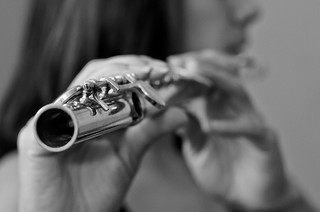 Digital Media Rights is a private registry of intellectual property specialized in creations in digital format, where musicians and producers can register their works and thus count on strong proof of original authorship with legal validity in 164 countries.
When registering your musical work in Digital Media Rights, musicians, authors and performers receive a digital certificate which, by an inviolable time stamp, certifies the date of creation or original interpretation, able to be used in any type of litigation as a result of plagiarism or unauthorized use of his work.
Step 1: SingUp in DMRights.com (It is free and you can certify digital works for no cost up to 200 MB of space)
Step 2: Select the type of work to certify: Musical score, creation with or without lyrics, musical recording, or others…
Step 3: Upload the file that contains your work in MP3, PDF, DOC, etc.
Step 4: Select your desired copyright license; All rights reserved, Creative Commons, etc.
In a few seconds and completely one, our registration system will return you the copyright certificate, recognizing your rights over the work.
Registration of copyright for musical creations.
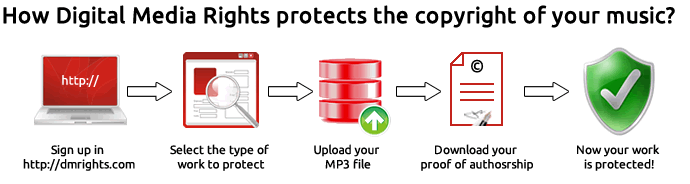 How does it work?
In accordance with existing international law, there is no obligation to register the artistic works in state intellectual property registries for the rights of any author to be recognized.
In this regard and in any conflict by plagiarism or illegal use by third parties of your creations, as the original author of the work, you must always provide a proof of your creation in a point in time. This “moment in time” is the most valued detail by judges or legal mediators. The certificates of Digital Media Rights incorporate a digital and in violable time stamp, giving faith to the moment at which the certification of the work is realized on its behalf.
Also Digital Media Rights allows you to certify different versions or variations of your creations thereby obtaining complete protection of your work. The content of the certified works in Digital Media Rights is considered confidential and as such is not accessible to the public.
With few exceptions, the recognition of copyright over a work extends throughout the life of the author and 75 additional years after his death.
The symbol ℗ represents the reserve of copyrights over a recording; and is an abbreviation of the Word “phonograph” or phonographic record. This symbol references the sound recording and it is very common to see it printed on the back covers of disks. The symbol ℗ is equivalent to ©, using the latter references copyright which protects intellectual works like lyrics and music of a song (written), books, dramatic arts, cinematographic and audiovisual works; drawings, paintings; computer programs, etc.